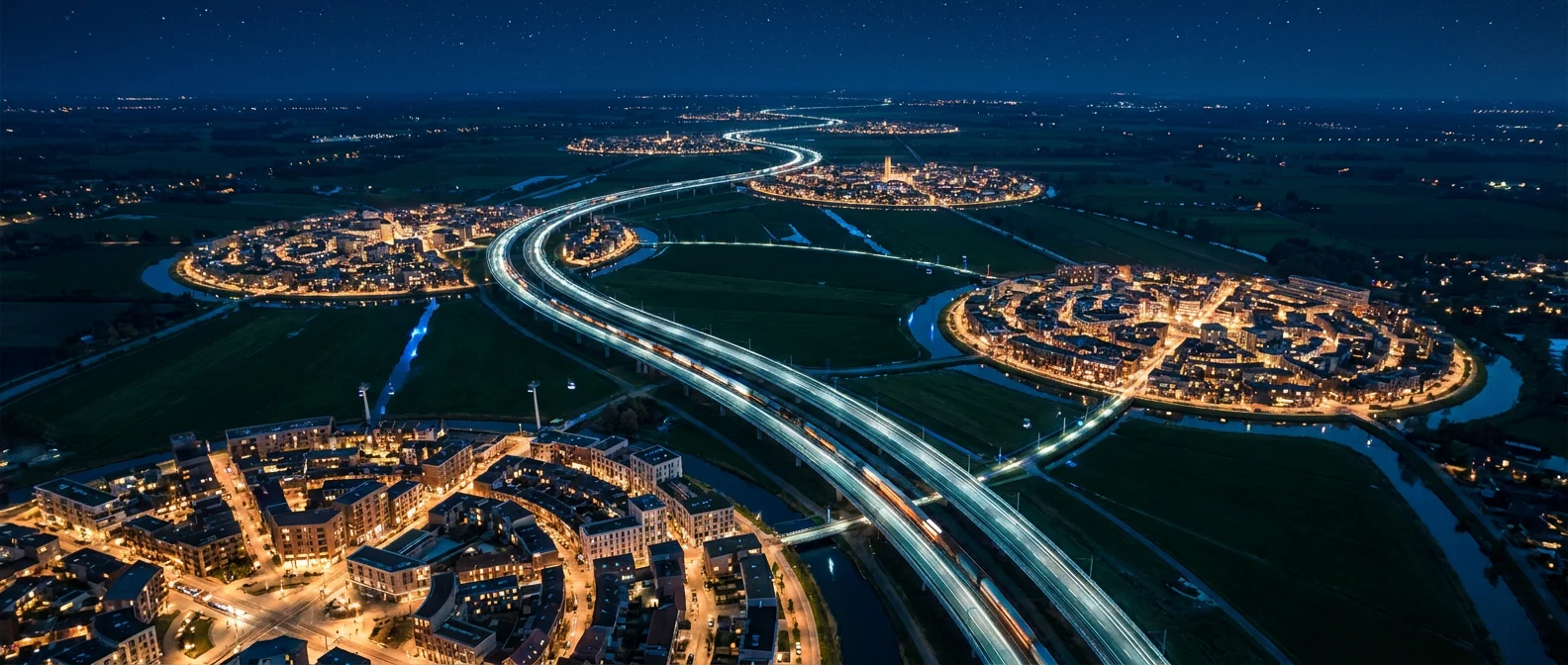
Aerial view of Argenta: five circular city nodes beaded along a gleaming rail spine

THE FEASIBILITY STUDY, AT SCALE · SISTER CITY OF AURELIA

ARGENTA

The working city of one million — five garden-city wheels beaded on an industrial rail spine. Where Aurelia perfected the neighborhood, Argenta industrializes the dream. Bring your big projects.

0residents across five wheels
0 minend of spine to end of spine
0kpeople per hour on the metro trunk
0 theaviest street-legal load, by permit
00 · WHAT BREAKS AT A MILLION

The wheel was never
meant to be a planet

A radial city's transit capacity scales with the circumference of its core — not with its population. Every line funnels into one Transit Lobby; quadruple the residents and you need four times the throughput through a center whose perimeter cannot grow. Geometry joins the betrayal: four times the area means twice the radius, and the fifteen-minute promise dies somewhere around kilometer five. And the beloved gondola — 4,000 people per hour per direction — is a capillary being asked to do an artery's job.

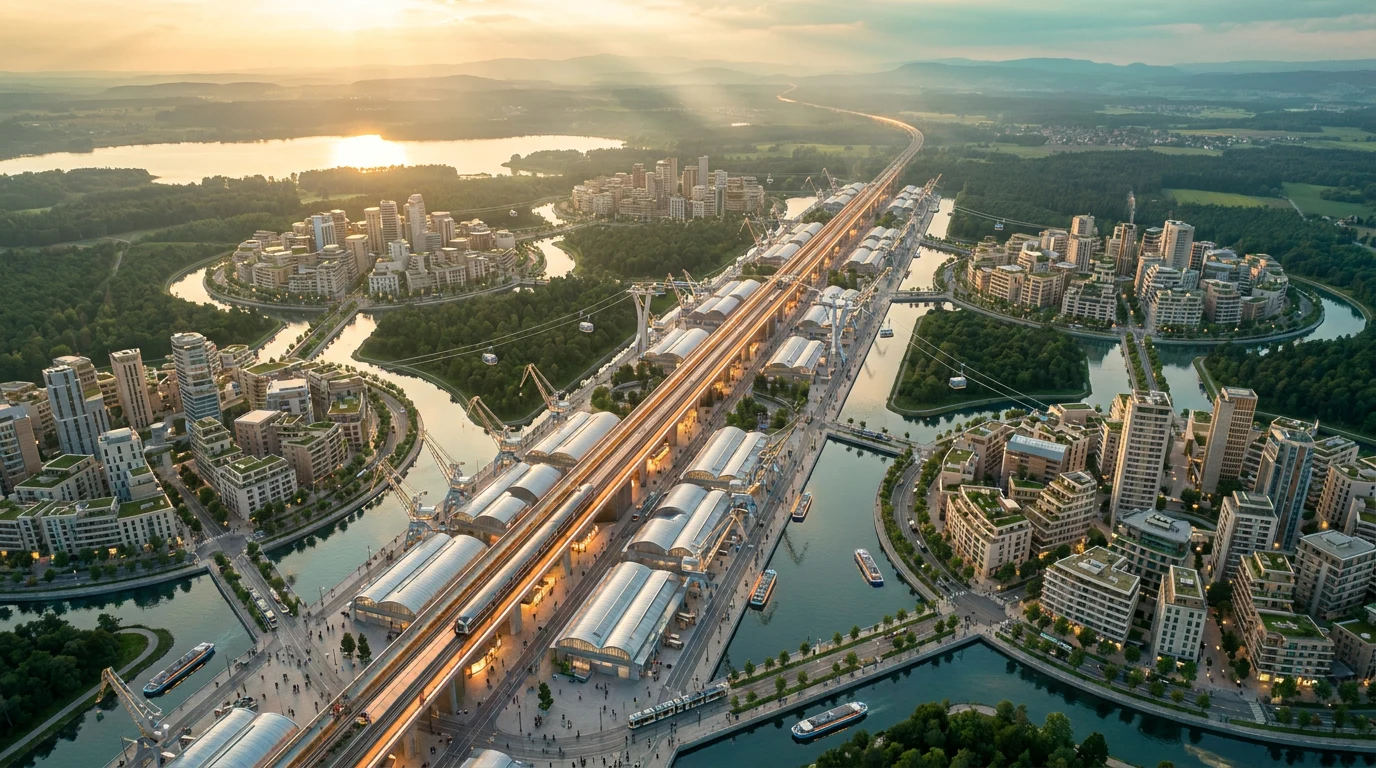
So Argenta doesn't stretch the wheel. It strings five of them on a spine — Copenhagen's Finger Plan, Stockholm's satellite towns, Tokyo's rail mesh, all of which have carried millions for the better part of a century. Each wheel keeps the neighborhood life Aurelia perfected. The spine between them carries what a million people actually generate: labor markets, freight, and ambition. Aurelia herself is here — she's the first bead.

LAW 04

Give goods their own network

Parcels in pods are not a freight policy. A working city moves steel, timber and kilns — on rails, water, and permitted streets, by design.

LAW 05

Car-free never meant work-free

Every street is engineered for a 60-tonne permitted load and a fire truck. What's banned is the parked private car — not the crane, the flatbed, or the moving day.

LAW 06

Industry lives downtown-adjacent

The Works gets the best logistics land in the city, not the leftovers behind the farm belt. A city that hides its industry ends up hiding its purpose.
01 · THE CONSTELLATION

Five wheels,
one silver spine

Twenty-four kilometers end to end. Each bead is a complete 15-minute city of ~200,000; between them run the green wedges, the canal, and the four districts of The Works. Touch the spine to explore it.

02 · THE TRUNK

The gondola learns
its true calling

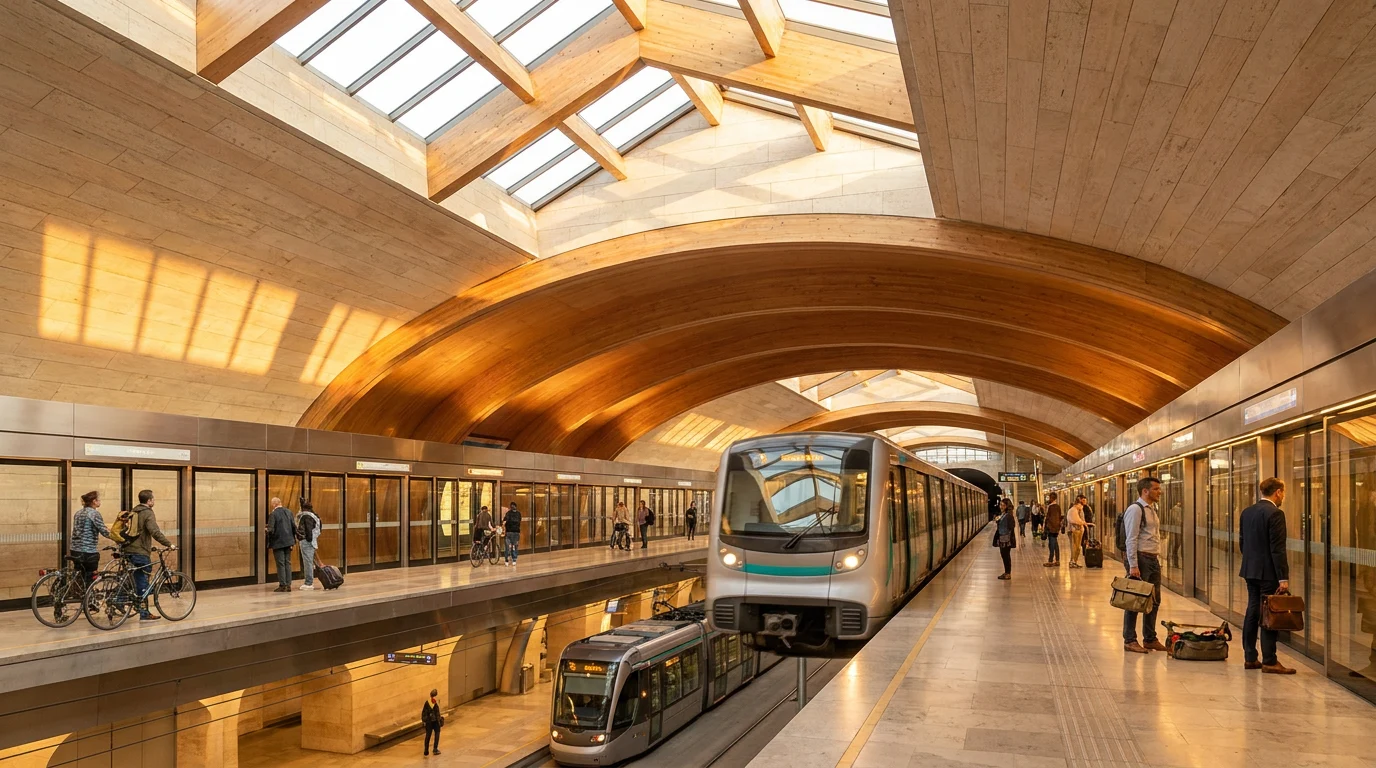
At a million people the roles invert: the driverless metro pair under the spine becomes the artery, and the gondolas — thirty feeder lines now — do what La Paz and Medellín actually use them for: the last two kilometers, up and over anything, every twelve seconds.

Cathedral-like timber-vaulted driverless metro station beneath Argenta
CORRIDEN UNDERCROFT · EXPRESS PLATFORM, 90-SECOND HEADWAYS

What each mode can actually carry — people per hour per direction, typical peak

GONDOLA FIGURES · MONOCABLE ≈ 4,000 / 3S ≈ 5,500 · DRIVERLESS METRO PER COPENHAGEN / SKYTRAIN CLASS · REGIONAL RAIL PER RER-CLASS TRUNKS

03 · FREIGHT

Four networks
for heavy things

Aurelia's parcel pods were the polite answer. Argenta gives goods a full stack — because somebody's kiln, somebody's keel, somebody's sixty-tonne press is always arriving, and pretending otherwise is how cities become museums.

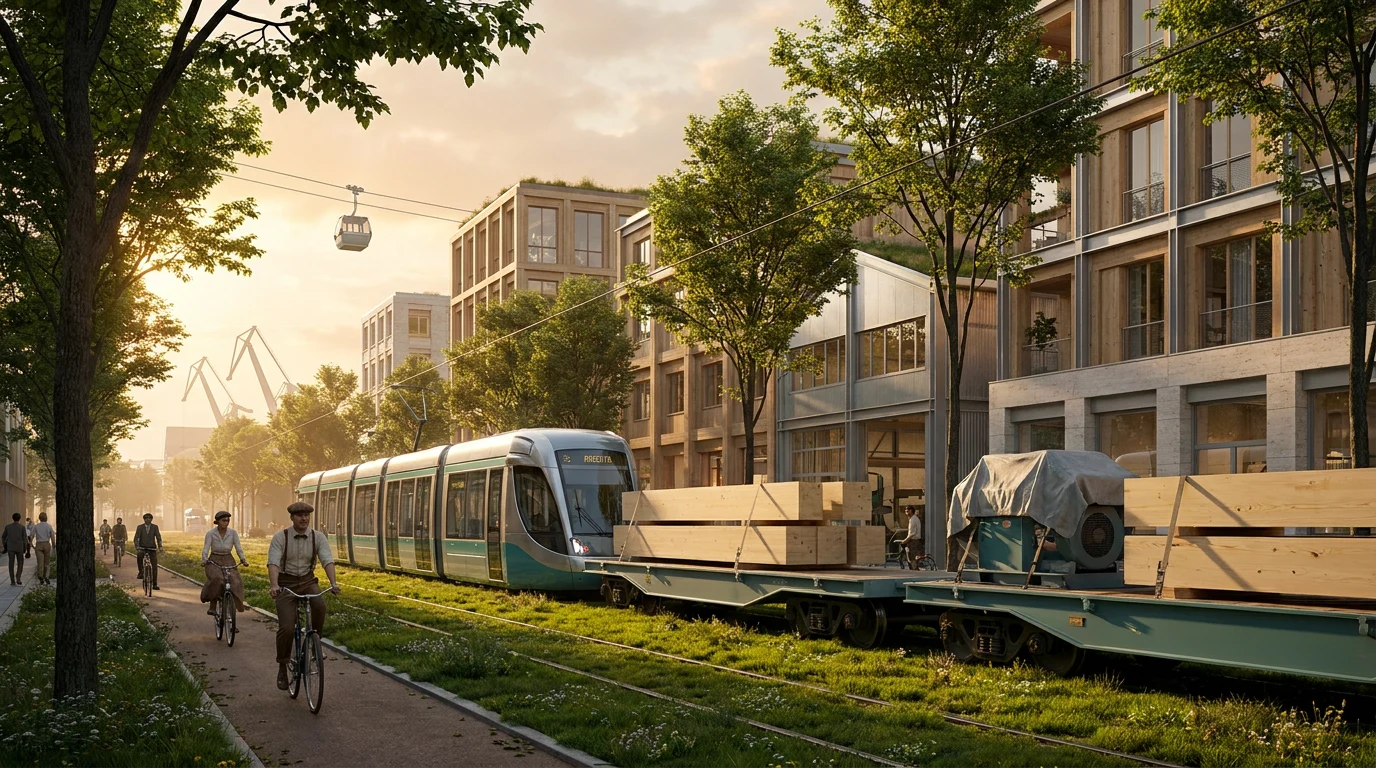
A silver cargo tram hauling timber beams and machinery along a grass-track boulevard
NETWORK I · STEEL WHEELS

Rails to every workshop door

The spine's second track pair is for freight and regional trains; from it, sidings thread into every district of The Works — the Swiss habit of giving factories their own rails. Cargo trams shuttle the middle weights: Dresden's CarGoTram hauled sixty-tonne loads through a city center for two decades, and Zurich still collects by tram today.

  • siding within 300 m of every big bay
  • 60 t per tram consist
  • zero road wear, zero diesel
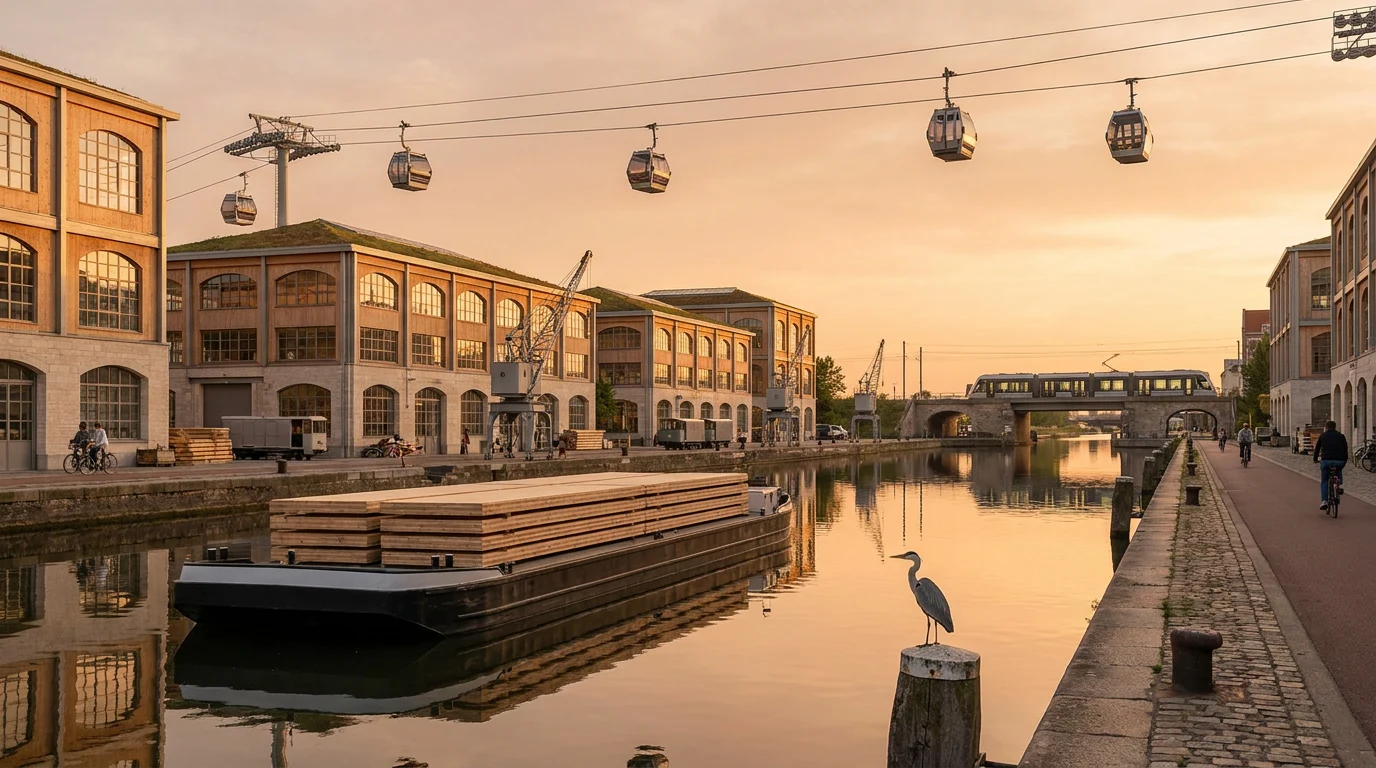
An electric barge loaded with timber panels gliding a tree-lined canal past workshops
NETWORK II · THE SILVER CANAL

Bulk moves at three knots

The canal parallels the spine from the lake to the last wheel, and it is a working waterway: aggregate, timber, oversize tanks — anything heavy and unhurried travels by electric barge, the way Amsterdam still feeds its construction sites through canals dug four centuries ago. The tow path is the city's favorite cycling commute; the herons supervise the locks.

  • 350 t per barge
  • quietest freight mode ever devised
  • doubles as cloudburst drainage
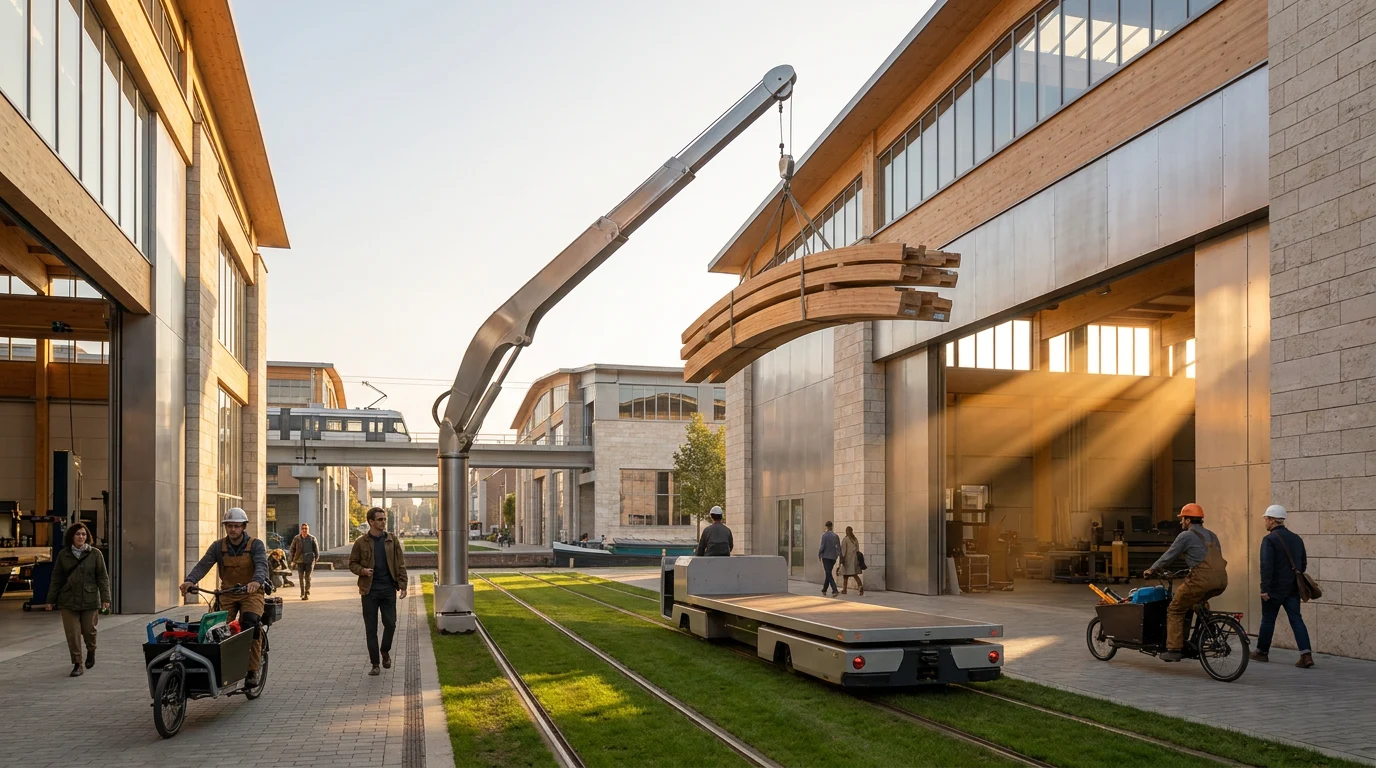
Inside The Works: timber-and-steel workshops, a gantry crane lifting beams, a cargo tram passing
NETWORK III · THE DEEP LEVEL

Walt's truck roads, finally built

The 1966 EPCOT drawings never showed parcel pods — they showed full truck routes running beneath the city. Argenta builds them: five-meter-clear freight utilidors under the spine and into each wheel's core, so a semi can reach any district's docks without ever seeing a plaza. Above, you hear fountains; below, the morning rush of 300 electric trucks.

  • 5 m clear height mains
  • every core reachable below grade
  • as drawn in 1966
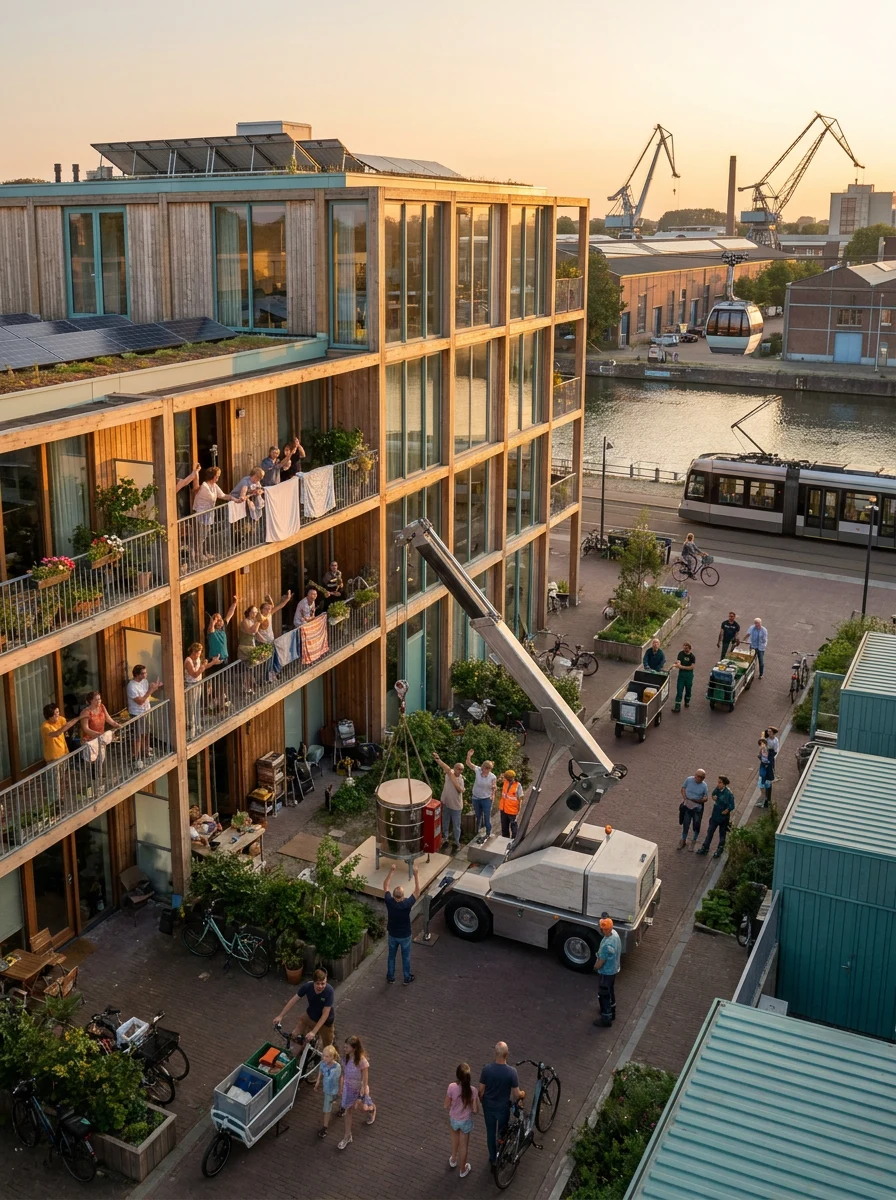
A compact mobile crane lowering a kiln into a residential courtyard while neighbors help
NETWORK IV · THE PERMITTED SURFACE

Any street, any load — on asking

Here is the honest secret of every great pedestrian city: the streets were never closed to work. Pontevedra admits delivery windows and moving vans; every Argentan street is engineered for a fire truck and a 60-tonne permitted transport at walking pace. A crane on your block Saturday morning is a two-tap permit, and the neighbors mostly come to watch.

  • crane permit ≈ 4 min, same-day
  • walking-pace escort loads
  • what's banned is parking, not working
04 · THE WORKS

Industry with
the best seat in the house

Four gridded districts strung directly on the spine — because grids, not wheels, are what industry loves: no privileged center, any block a factory, capacity added by adding parallel streets. Barcelona's Eixample logic, zoned the generous Japanese way.

01

24/7 freight rights, forever

The Works never sleeps and never apologizes. Its charter guarantees round-the-clock rail, barge and utilidor access — the covenant that lets a foundry invest for fifty years.

02

Process heat over the fence

The energy campus sells steam and 3¢ off-peak nuclear kilowatt-hours directly to the big bays. Glass, ceramics, precision forging — the crafts that follow cheap clean heat — follow it here.

03

The messy middle is legal

Zoning runs on the inclusive Japanese model: quiet workshops mix into every wheel, and only the genuinely loud or hazardous concentrates in The Works. A luthier never needed an industrial park; a drop forge never belonged next to a nursery. Both get what they need.

04

Apprenticeship as infrastructure

Every big bay hosts apprentices from the wheel schools — the Mittelstand habit that keeps skills, wages and pride circulating between the plazas and the presses.

4works districts on the spine — each a 40-hectare grid with sidings, docks and big bays
214 MWof process heat and steam sold over the fence by the energy campus
2 minfrom any big bay to a rail siding, by gantry or yard tractor
0industrial districts hidden behind a greenbelt where nobody has to think about them
05 · BIG PROJECTS

A city for people
who make things

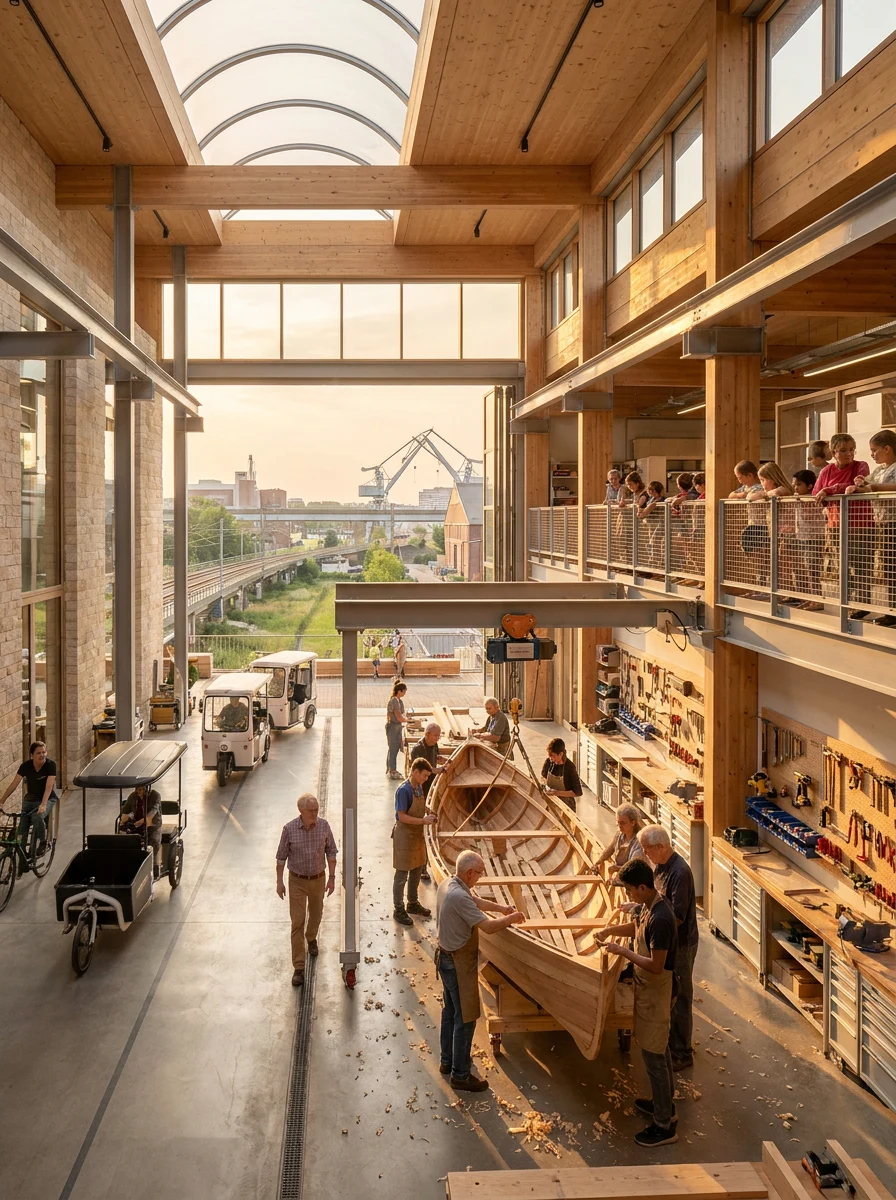
The measure of Argenta is simple: a resident can build a boat in their courtyard without owning a truck. Sometimes people just have big plans — the city's job is to say yes quickly.

Residents building a wooden sailboat under a bridge crane in a grand neighborhood maker hall
VAYLE WHEEL MAKER HALL · HULL Nº3 OF THE SPRING REGATTA

A maker hall in every village

Not a hobby room — a hall: bridge crane, tool wall, spray booth, CNC queue, and a freight dock on the utilidor. Your kiln arrives below grade and rises by lift; the hall master signs for it before you're home.

The fleet you don't own

The car-share vaults at each wheel's edge stock box trucks, flatbeds and 300-kg cargo trikes alongside the runabouts — the open secret of Vauban, where "car-free" households rent vans constantly and nobody calls it cheating.

The Saturday Crane

Oversize move? The permit app books a compact crane, an escort walker and a street window in about four minutes. Forty-odd are granted daily, and a courtyard crane lift remains the second-best free entertainment in the city, after the locks.

Yes is the default

The bylaw is written in the permissive voice: any project that doesn't endanger or permanently take from the commons is approved by default, with the burden of objection on the city. Argenta assumes its residents are up to something — and likes it.

06 · THE RECEIPTS

Scale has
precedents too

Law 01 still governs: every load-bearing claim, and the place on Earth already carrying the load.

Argenta at night: the illuminated rail spine and five glowing city nodes receding to the horizon
07 · ONE RESIDENT'S SATURDAY

The boat,
the crane, the kiln

  1. 06:10

    Mara's glulam keel timbers leave the sawmill in The Works on cargo tram Nº7. She watches the manifest update from bed, then goes back to sleep.

  2. 08:30

    Express to Vayle, eleven minutes. The timbers are already at the maker hall dock, signed in by the hall master, smelling like a forest with plans.

  3. 10:00

    Two blocks over, a Saturday Crane sets a pottery kiln into the Benettis' courtyard. Forty neighbors watch. The crane operator takes a bow.

  4. 14:20

    Steam-bending at the hall. An apprentice from the wheel school clamps while Mara sings off-key. The bridge crane holds the hull like a patient parent.

  5. 18:45

    Barge Nº12 slides through Lock 2 loaded with next month's CLT, and the towpath cyclists ring their bells at it, as is custom.

  6. 22:30

    From the hall's mezzanine: the spine glitters silver, five wheels glow amber, a freight train hums south. Somewhere in Aurelia, the fireflies are out. Here, it's wood shavings and lamplight.